Please tell us about your requirement. A Friends Steel representative will contact you shortly.
×Learn • Understand • Build Better
Steel is the foundation of the industrial economy. Explore history, growth, technology, and modern construction steel — all in one place.
Steel is the backbone of India’s industrial growth, powering infrastructure,
manufacturing, and economic development.
Over the last decade, strong private sector participation and government
support have transformed the industry—driving higher production, rising
domestic demand, and global competitiveness.
With the National Steel Policy and advanced manufacturing technologies,
India’s steel sector continues to evolve as a future-ready engine of growth.
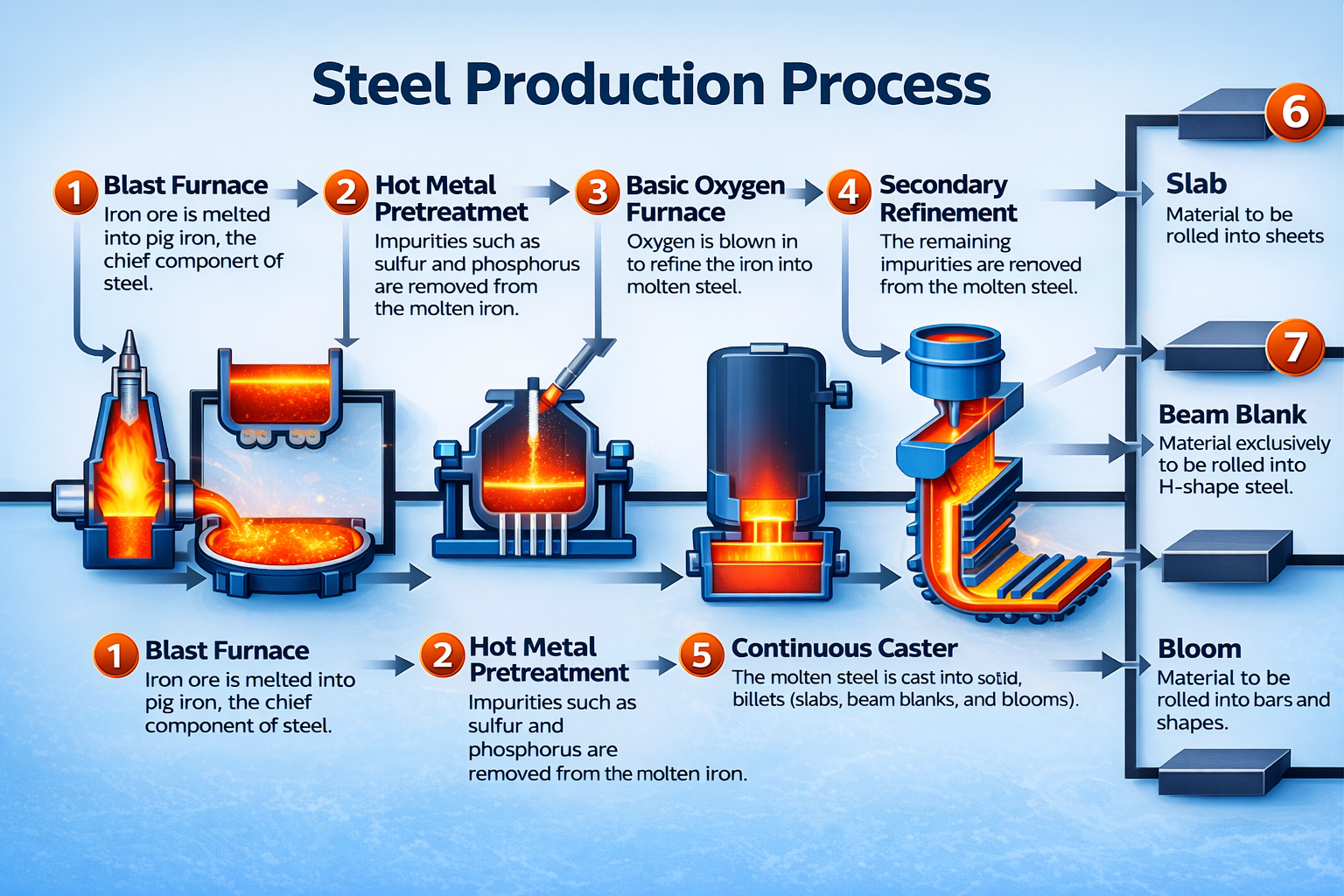
KNOWLEDGE HUB — STEEL PRODUCTION
A simplified view of how raw materials are transformed into finished steel.
Iron ore is melted to produce hot metal.
Impurities like sulfur and phosphorus are reduced.
Oxygen blowing and chemistry control create clean steel.
Molten steel is cast into slabs, blooms and beam blanks.
EVOLUTION OF CONSTRUCTION STEEL
Grade: 250–300
Grade: 350–375
Grade: 415–435
Grade: 500–550
Friends 500 HD bars combine superior strength (hardened tempered martensite periphery) and higher ductility
(soft ferrite-pearlite core) to support seismic design. Greater yield strength and higher fatigue resistance
make it suitable for earthquake-prone areas — with standards over and above BIS.
The hardened outer casing forms a protective coat that improves corrosion resistance. The special
microstructure also provides excellent bendability — allowing sharper, accurate bends around mandrels.
To obtain maximum advantage, refer “Good Operational Practices at Construction Sites” leaflet.
Private sector growth, government policy support, and technology upgrades shaping the next decade.
The private sector has played a huge role in bolstering India’s steel industry with robust growth over the last 10–12 years.
Growth catalyst.Since 2008, production increased by 75% and domestic demand increased by 80% — driving scale and competitiveness.
Demand-led momentum.The National Steel Policy (2017) envisions the growth trajectory of the Indian steel industry till 2030–31, emphasising state-of-the-art technology.
Vision till 2030–31.Innovations such as Corex, Thin Slab Casting, Compact Strip Mill, DC Electric Arc Furnaces, and Twin Shells AC EAFs reflect India’s technology advancement.
Modern steelmaking.Steel manufacturing accounts for roughly 7% of global CO₂ emissions. India became the world's first country to publish an official Green Steel Taxonomy in December 2024 — defining how "green" your steel really is.
As per the Ministry of Steel, "Green Steel" is steel made by plants whose CO₂ emission intensity is less than 2.2 tonnes of CO₂-equivalent per tonne of finished steel. The lower the emissions, the higher the "% green" rating. The taxonomy creates a transparent benchmark so buyers, regulators and end-users can compare steel on its climate impact, not just its strength.
Steel is one of the most infinitely recyclable materials on earth — every tonne reused saves around 1.5 tonnes of CO₂ and 1.4 tonnes of iron ore. A circular steel economy means designing, producing, using and recovering steel so the same metal keeps cycling through new buildings, vehicles and infrastructure.
Recognised by India's Green Steel Mission roadmap.
We follow the Ministry of Steel's roadmap on energy efficiency, scrap recycling and cleaner process design — building TMT bars, structural steel and pipes that do not just hold up your building, but also lighten the planet's load.
Useful links to learn more about steel, the industry, and Friends Steel.
